
British Army Lt Col Herbert Jones: Victoria Cross Recipient Falklands War
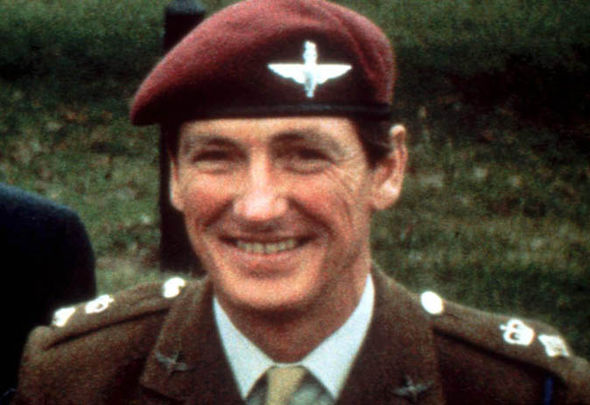
Herbert “H.” Jones was born on May 14, 1940, in Putney, London, England. After graduating from the Royal Military Academy Sandhurst, he was commissioned into the British Army as a second lieutenant in July 1960.
Jones later rose to the rank of major and served in Northern Ireland during the Troubles. While there, he was involved in efforts to locate the captured British Army officer, Captain Robert Nairac. Although Nairac was not recovered alive, Jones was appointed a Member of the Order of the British Empire (MBE) for his service.
On May 28, 1982, now a lieutenant colonel, Jones was commanding the 2nd Battalion, The Parachute Regiment (2 Para), during the assault on Argentine positions at Darwin and Goose Green in the Falklands War.
The enemy was well dug in along a critical ridge with mutually supporting defensive positions. As the battalion advanced, it was pinned down south of Darwin by at least eleven entrenched positions. Casualties mounted, and the attack stalled under heavy and accurate fire.
Determined to regain momentum, Lieutenant Colonel Jones moved forward with his reconnaissance party to assess the situation firsthand. From an exposed position near the front, he directed mortar fire in an effort to suppress the enemy. But the Argentine defenses were well prepared and continued to pour fire into his men.
With the assault faltering and further casualties likely, Jones knew decisive action was required.
Seizing a submachine gun, he called to those around him and charged the nearest enemy trench.
Under intense fire from multiple positions, he was seen fall and roll down the slope before rising and charging again, firing as he advanced. He pressed the attack to within a few feet of the enemy before being mortally wounded.
Shortly afterward, his battalion renewed the assault, ultimately forcing the surrender of approximately 1,200 Argentine troops.
His personal leadership under devastating fire reignited the attack and helped change the course of the battle.
For his extraordinary courage and leadership, Lieutenant Colonel Herbert Jones was posthumously awarded the Victoria Cross, the highest military award of the British Armed Forces.
You can watch a short video about his story here: https://youtube.com/shorts/xTLi9QROIxA
Victoria Cross Citation:
On 28th May 1982 Lieutenant Colonel Jones was commanding 2nd Battalion The Parachute Regiment on operations on the Falkland Islands. The Battalion was ordered to attack enemy positions in and around the settlements of Darwin and Goose Green. During the attack against an enemy who was well dug in with mutually supporting positions sited in depth, the Battalion was held up just South of Darwin by a particularly well-prepared and resilient enemy position of at least eleven trenches on an important ridge. A number of casualties were received. In order to read the battle fully and to ensure that the momentum of his attack was not lost, Colonel Jones took forward his reconnaissance party to the foot of a re-entrant which a section of his Battalion had just secured. Despite persistent, heavy and accurate fire the reconnaissance party gained the top of the re-entrant, at approximately the same height as the enemy positions. From here Colonel Jones encouraged the direction of his Battalion mortar fire, in an effort to neutralise the enemy positions. However, these had been well prepared and continued to pour effective fire onto the Battalion advance, which, by now held up for over an hour and under increasingly heavy artillery fire, was in danger of faltering. In his effort to gain a good viewpoint, Colonel Jones was now at the very front of his Battalion. It was clear to him that desperate measures were needed in order to overcome the enemy position and rekindle the attack, and that unless these measures were taken promptly the Battalion would sustain increasing casualties and the attack perhaps even fail. It was time for personal leadership and action. Colonel Jones immediately seized a sub-machine gun, and, calling on those around him and with total disregard for his own safety, charged the nearest enemy position. This action exposed him to fire from a number of trenches. As he charged up a short slope at the enemy position he was seen to fall and roll backward downhill. He immediately picked himself up, and again charged the enemy trench, firing his sub-machine gun and seemingly oblivious to the intense fire directed at him. He was hit by fire from another trench which he outflanked, and fell dying only a few feet from the enemy he had assaulted. A short time later a company of the Battalion attacked the enemy, who quickly surrendered. The display of courage by Colonel Jones had completely undermined their will to fight further.
Thereafter the momentum of the attack was rapidly regained, Darwin and Goose Green were liberated, and the Battalion released the local inhabitants unharmed and forced the surrender of some 1,200 of the enemy.
The achievements of 2nd Battalion The Parachute Regiment at Darwin and Goose Green set the tone for the subsequent land victory on the Falklands. The British achieved such a moral superiority over the enemy in this first battle that, despite the advantages of numbers and selection of battle-ground, the Argentinian troops never thereafter doubted either the superior fighting qualities of the British troops, nor their own inevitable defeat.
This was an action of the utmost gallantry by a Commanding Officer whose dashing leadership and courage throughout the battle were an inspiration to all about him.

USMC Cpl John Pruitt: Double Medal of Honor Recipient WWI
